The New Era of SEO: How to Prepare a Website for AI Search Engines (GEO & AEO)
The way people search for information online is changing fast.
For years, the main goal for website owners was to rank high on Google and drive visitors to their site. Today, a new player has entered this process - artificial intelligence systems.
ChatGPT, Perplexity, Google's AI features, and other modern assistants no longer just show users a list of websites. They gather information from multiple sources, analyze it, and often hand users a ready-made answer.
This means that ranking well on Google alone may no longer be enough for businesses. It's just as important that AI systems can correctly find, understand, and - when relevant - use your website's information in their answers.
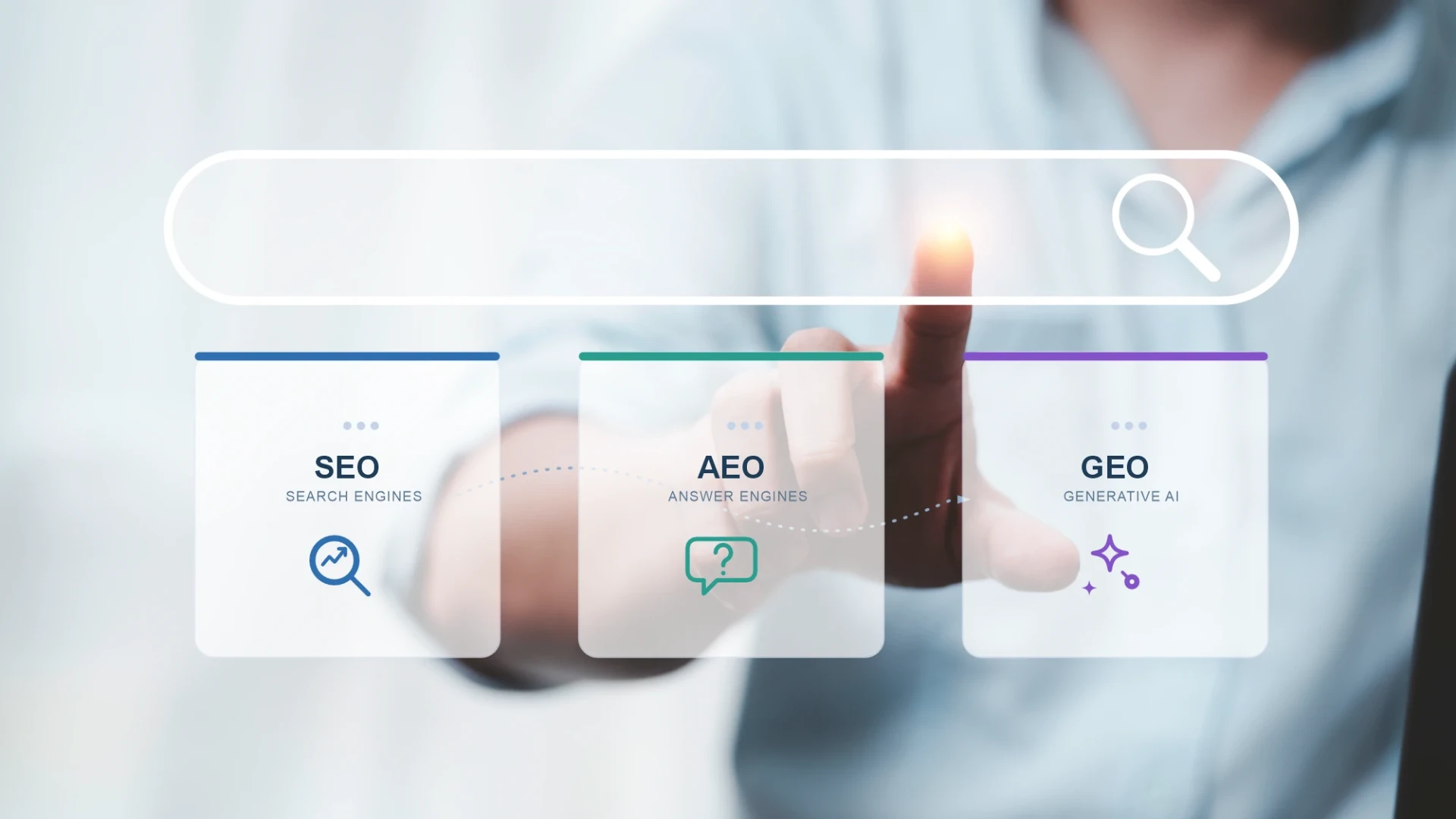
This is where two new terms come in - GEO (Generative Engine Optimization) and AEO (Answer Engine Optimization).
What Are GEO and AEO?
AEO (Answer Engine Optimization) means preparing your website and its content so that when users ask specific questions, search assistants can easily find and use your information to answer them.
For example, if someone searches: “How much does it cost to build a website in Tbilisi?”
It matters that your site has clear, useful information that actually answers that question.
GEO (Generative Engine Optimization) is a broader approach. Its goal is to make your website's information easy for modern AI systems - which generate answers by pulling from many sources - to understand and use.
Put simply: SEO tries to get users to find your site. AEO tries to get your information used as a direct answer. GEO tries to make your content visible and understandable within AI-driven search environments too.
These approaches aren't replacements for one another - on the contrary, they're closely connected.
3 Key Principles for GEO/AEO Optimization
If you want your website to be well-prepared not just for Google, but for AI search systems too, there are a few simple principles worth keeping in mind.
1. Give Users the Answer Right Away
Neither people nor search systems want to wade through a long introduction before reaching the main point.
Indicator: The article takes several paragraphs to reach the actual answer, instead of giving readers the answer upfront.
Fix: At the start of each key section of an article or page, state the main answer or takeaway clearly, then go into detail afterward.
2. Keep Information Clear and Logically Organized
AI systems have to process large volumes of information, so it's important that your website's content is organized and easy to distinguish.
Indicator: The page lacks clear headings, subheadings, lists, or structured data - the kind of markup that helps search systems understand what a given page is actually about.
Fix: Use clear headings, short paragraphs, lists, and concrete facts, and implement Schema Markup (Article, Product, FAQPage) to clearly signal your page's content to AI systems.
3. Make Your Site Accessible to Both People and Search Systems
Writing a great article isn't enough if search systems struggle to find and read it.
Indicator: The site loads slowly, relies heavily on client-side JavaScript, or blocks important pages from search systems.
Fix: Implement Server-Side Rendering (SSR) or pre-rendering so the core text content is accessible as soon as the site loads.
Good Writing Alone Isn't Enough
For AI search systems, what matters isn't just what you say, but how trustworthy that information is.
Indicator: The page doesn't show the author, the company behind the information, the source of the data, or when it was last updated - a particular problem for topics like finance, health, legal matters, or professional services.
Fix: Clearly credit the author and source, update content regularly, and highlight relevant expertise - all of which increase your content's credibility in the eyes of AI.
Is SEO Dead?
No. SEO isn't dead - it's evolving.
Traditional SEO still matters a great deal. A technically sound website, strong content, authority, quality backlinks, and genuinely useful information still form the foundation of a website's visibility. The search landscape is simply expanding.
The old core question used to be: “What position do we rank at on Google?”
Today, new questions need asking too: “How are users finding our information?”, “Can AI correctly understand our content?”, “Is our information clear and trustworthy enough to be included in an AI-generated answer?”
So GEO and AEO aren't replacements for traditional SEO - they're part of the new reality of search.
Conclusion
AI-driven search is still evolving fast, and its final shape hasn't settled yet. But one thing is already clear - users are increasingly turning not just to search engines, but to AI assistants as well to find information. That's why it's worth preparing your website for this new reality now.
Start with the fundamentals: a technically sound website → useful, clear content → the right structure → trustworthy information → accessibility for search systems.
Ultimately, a well-built website is, first and foremost, good for people - and that's precisely why it's easier for modern search systems to understand too.
Want to know how ready your website is to show up in AI-generated answers? Email us or Call us for a free technical and content audit.